

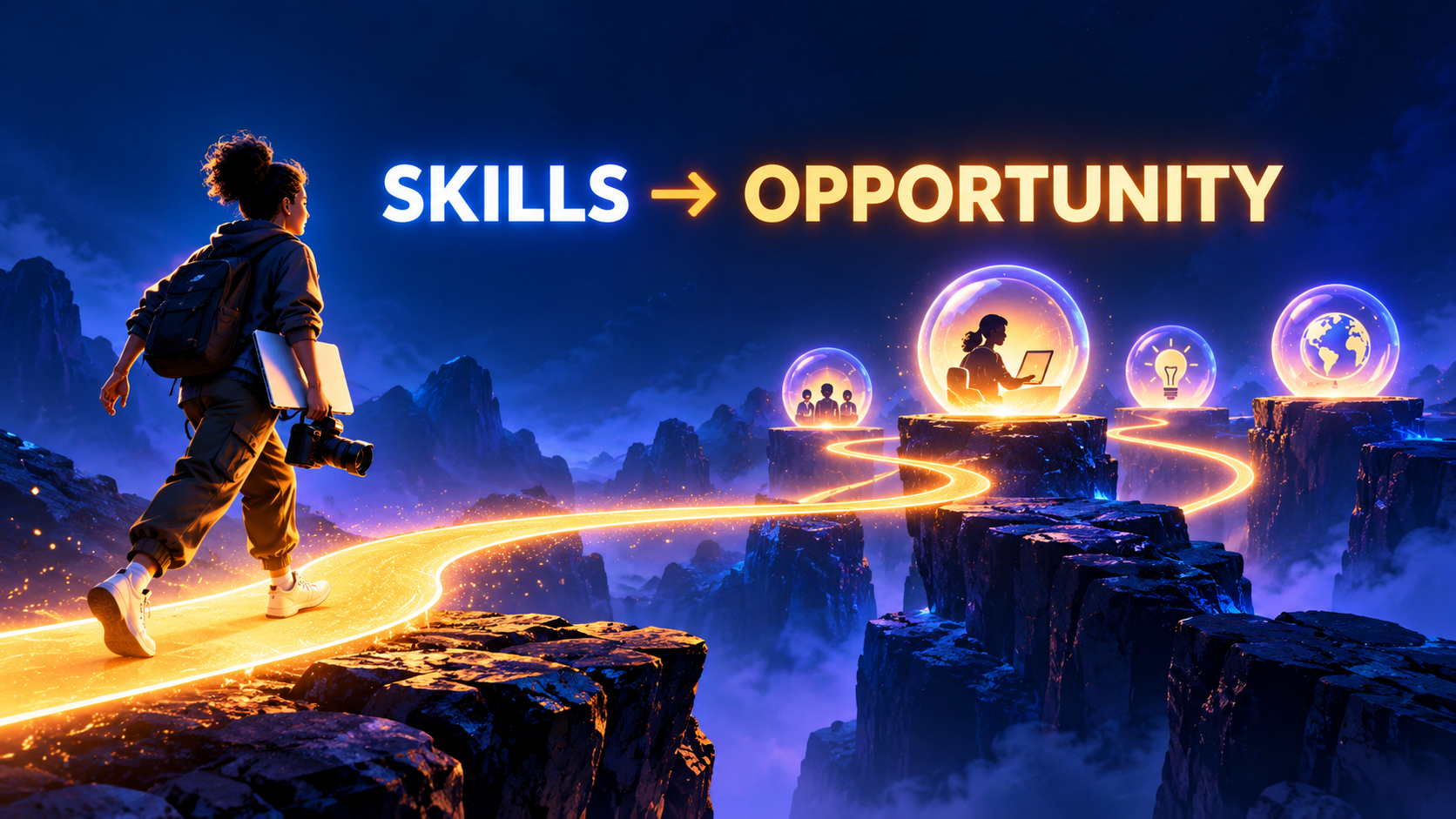
How Emerging Creators Can Turn Skills Into Real Opportunities
Talent is common. Visible, trusted evidence of talent is much harder to find.
Many emerging creators can write, design, edit, act, photograph, compose or develop ideas, but still struggle to move from ability to opportunity. The problem is not always a lack of skill. Often, the missing link is a clear way to show what they can do, connect with a real need and complete work that others can verify.
This guide explains a practical path from skill to opportunity without pretending that success happens overnight.
1. DEFINE THE VALUE YOU CAN CREATE
“I am creative” is an identity, not an offer. People who need help must understand what you can contribute.
Replace broad descriptions with a simple capability statement. For example: “I edit short promotional videos for independent brands,” “I write dialogue for Hindi web series,” or “I design social-media posters for events.” A focused statement does not limit your future. It helps the right person understand where you can begin.
2. BUILD PROOF BEFORE WAITING FOR PERMISSION
A portfolio does not need to begin with a famous client. It can begin with self-initiated work, a carefully completed challenge, a collaboration or a thoughtful solution to a real problem.
Create a small set of strong examples. Explain the brief, your role, the process and the result. If a project was conceptual rather than commissioned, label it honestly. Clear context builds more trust than exaggerated claims.
3. TURN YOUR PROFILE INTO A CAPABILITY PAGE
Your profile should help someone answer four questions quickly: Who are you? What can you do? What have you completed? What kind of opportunity are you seeking?
Use a recognisable photograph or professional identity, a specific headline, a concise introduction and links to relevant work. Remove copied descriptions, unrelated posts and claims you cannot support. A clean profile is easier to trust.
4. LOOK FOR PROBLEMS, NOT ONLY JOB TITLES
Opportunities often appear as needs: a filmmaker needs a poster, a small business needs product photographs, a creator needs subtitles, or a team needs research. If you search only for formal job titles, you may miss project-based ways to participate.
Read each brief carefully. Respond to the actual requirement. A useful reply explains your relevant skill, shows one suitable example and proposes a realistic next step.
5. START WITH A SMALL, CLEAR COLLABORATION
Before committing to a large project, define a small first deliverable. Agree on scope, deadline, ownership, credit, payment if applicable and how feedback will be handled. Written clarity protects both sides.
Do not pay unknown people simply to “unlock” a job. Verify identities and project details. Never share sensitive documents unless they are genuinely required and the recipient is trustworthy.
6. RECORD COMPLETED WORK AND FEEDBACK
A completed project is more useful when the contribution is documented. Save the brief, final output, permission to display the work and any genuine feedback. Over time, these records form evidence of reliability—not merely potential.
This creates a practical cycle: capability leads to participation, participation produces completed work, and completed work creates stronger access to future opportunities.
7. KEEP LEARNING FROM REAL PARTICIPATION
Courses can help, but creators also grow through briefs, deadlines, collaboration and feedback. After every project, ask what improved, what slowed the work and what should change next time. Update your portfolio with the strongest evidence, not every experiment.
A HUMANTECH APPROACH TO OPPORTUNITY
Technology should do more than collect attention. It should help people express capabilities, discover real needs, participate fairly and build trusted records of contribution.
Roshopion is developing as a HumanTech™ participation and opportunity platform for creators, talent, professionals, projects and businesses. The direction is simple: connect “I CAN” with “I NEED,” help participation become “I DID,” and make completed value easier to recognise.
If you are an emerging creator, begin with one clear capability, one honest proof of work and one real problem you can help solve. Opportunity becomes more likely when potential becomes visible, specific and useful.